
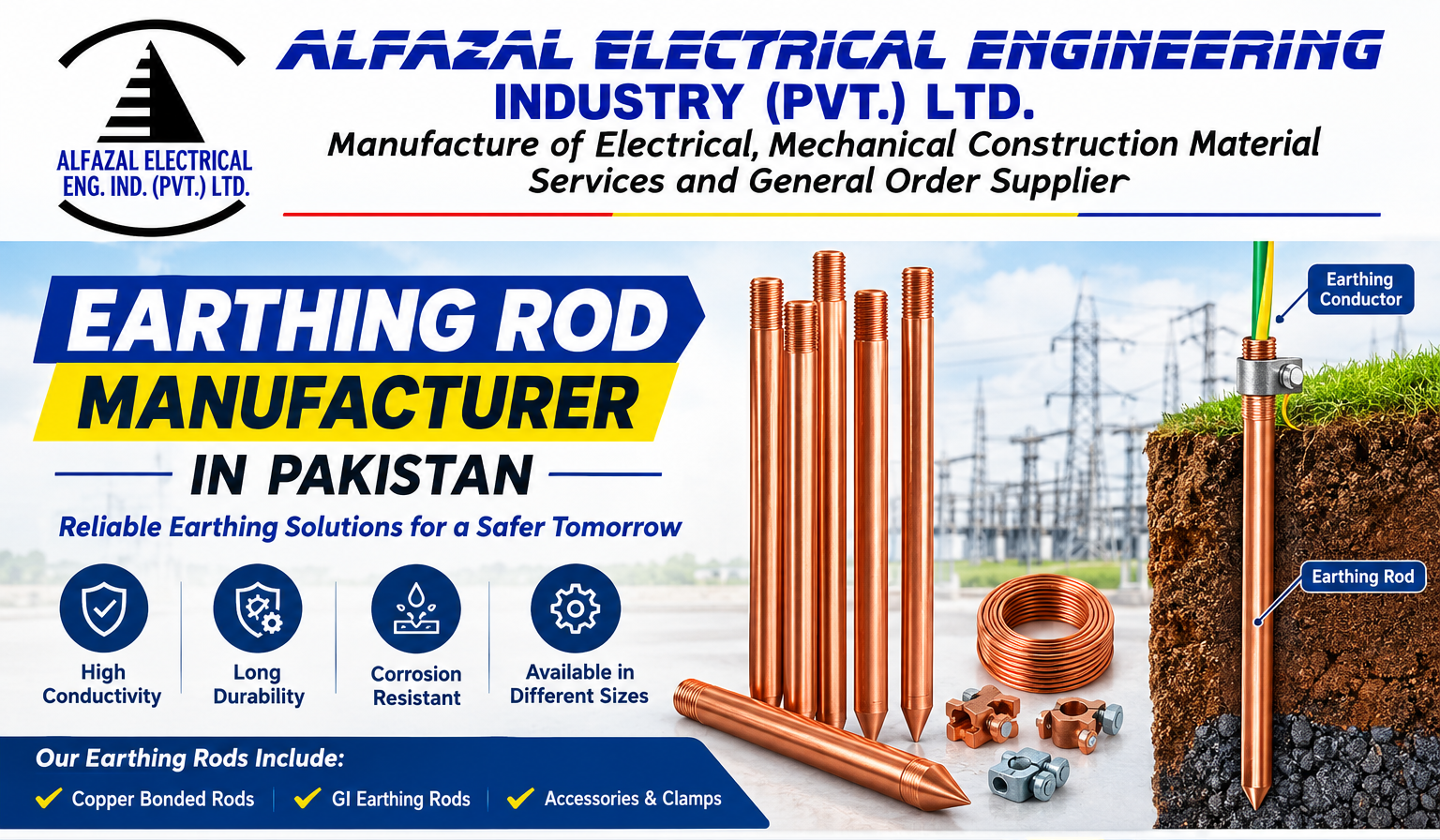
Earthing Rod Manufacturer in Pakistan.
Introduction to Earthing Systems in Pakistan
Electrical safety is an essential requirement for industrial facilities, commercial buildings, residential projects, solar power installations, and infrastructure developments. A reliable earthing system helps provide a safe path for fault current to flow into the ground, reducing the risk of electric shock, equipment damage, and electrical hazards. Selecting suitable earthing materials is therefore an important part of any electrical installation.
If you are looking for an earthing rod manufacturer in Pakistan, Alfazal Engineering offers electrical engineering products and solutions for a variety of industrial and commercial applications. From earthing rods and grounding accessories to conductive strips and lightning protection materials, choosing the correct products helps support a dependable and properly designed earthing system.
Earthing Rod
An earthing rod, also known as a ground rod or grounding electrode, is a conductive metal rod installed in the ground as part of an electrical earthing system. It connects to an earthing conductor, allowing fault current to pass into the grounding network when a suitable electrical fault occurs.
Earthing rods are widely used in factories, commercial buildings, power distribution systems, telecommunication installations, solar projects, and electrical substations. Their material, length, diameter, coating, and installation depth should be selected according to soil conditions, electrical design requirements, and applicable safety standards.
Types of Earthing Rods Available in Pakistan
Different applications require different types of earthing rods. Understanding their characteristics can help contractors, electrical engineers, procurement teams, and project developers choose the right solution.
1. Copper Bonded Earthing Rods
Copper bonded earthing rods feature a steel core with a copper layer bonded to the outer surface. This construction combines mechanical strength with the conductivity and corrosion resistance associated with copper. These rods are commonly used in commercial buildings, industrial plants, power distribution systems, and lightning protection installations.
Copper bonded rods are available in different lengths and diameters, depending on the project requirements. They can also be installed with compatible couplers and driving accessories when deeper electrodes are needed.
2. GI Earthing Rods
Galvanized iron (GI) earthing rods are made from iron or steel protected by a zinc coating. They are used in various electrical grounding applications where the specified design permits galvanized materials.
The service life of a GI earthing rod depends on coating quality, soil chemistry, moisture levels, and installation conditions. Proper material selection is important for achieving reliable performance in different environments.
3. Solid Copper Earthing Rods
Solid copper earthing rods are manufactured from copper throughout the rod body. Copper offers high electrical conductivity and good corrosion resistance in suitable environments. These rods may be specified for specialist grounding installations where solid copper electrodes are required.
Their selection should consider the electrical design, mechanical requirements, installation conditions, and overall project budget.
4. Stainless Steel Earthing Electrodes
Stainless steel electrodes may be suitable for selected installations where environmental corrosion resistance is a major consideration. The appropriate grade must be chosen according to the soil composition and exposure conditions.
Compatibility with other metals and connections should also be evaluated to reduce the risk of galvanic corrosion.
Complete Range of Earthing Materials
A reliable grounding system requires more than an earthing rod. Different components work together to create an effective connection between electrical equipment and the grounding network.
Earthing Strips
Copper and galvanized steel earthing strips are used to connect electrical equipment, distribution panels, structural steel, and grounding electrodes. They are commonly installed in factories, substations, commercial buildings, and industrial infrastructure projects.
The dimensions and material of an earthing strip should be determined according to the expected fault current, installation method, mechanical protection, and relevant electrical standards.
Earthing Wires and Conductors
Earthing wires and conductors connect electrical equipment and metallic enclosures to the grounding network. Depending on the design, these may include copper conductors, insulated protective conductors, or other approved materials.
Correct conductor sizing, secure connections, and appropriate routing are essential for maintaining electrical continuity.
Earthing Clamps and Connectors
Earthing clamps and connectors provide connections between earthing rods, conductors, strips, and other grounding components. Different types are available for rod-to-cable, rod-to-strip, and conductor-to-structure connections.
Selecting compatible connectors helps maintain mechanical strength and electrical continuity. Connections should be installed according to the manufacturer’s recommendations and the project’s specifications.
Earth Rod Couplers and Driving Heads
Earth rod couplers connect compatible threaded earthing rods to extend the electrode installation where required. Driving heads help protect the rod’s threaded end during installation.
These accessories are particularly useful when installing sectional earthing rods to reach the required depth. Correct sizing and compatibility are important for safe and effective installation.
Earthing Plates
Earthing plates are conductive plates installed underground as grounding electrodes in applications where plate electrodes are specified. Copper and galvanized steel options may be considered according to the project design and local requirements.
The plate’s dimensions, installation depth, surrounding soil, and conductor connections all influence the performance of the earthing arrangement.
Earth Pits and Inspection Chambers
Earth pits and inspection chambers provide access to grounding connections for inspection, testing, and maintenance. They help protect accessible connections from physical damage and make it easier for technicians to check the earthing system.
Suitable chamber dimensions and covers should be selected according to the installation location and expected loading conditions.
Lightning Protection Materials
Lightning protection systems use a combination of air terminals, down conductors, bonding components, earth electrodes, and suitable connectors. These components help provide a designed route for lightning current and support equipotential bonding.
Earthing rods may form part of the grounding arrangement, but the complete lightning protection system must be designed and installed according to applicable standards and site-specific risk assessments.
Importance of Earthing Materials in Industrial and Commercial Projects
Electrical earthing is important for factories, warehouses, offices, shopping centres, hospitals, power distribution facilities, and manufacturing units. A properly designed system helps reduce dangerous touch voltages and provides a suitable path for fault current to support the operation of protective devices.
Earthing is also relevant to solar installations, telecommunications equipment, generators, transformers, and electrical control panels. Each application may have different grounding requirements, making professional design and appropriate material selection essential.
It is important to understand that an earthing rod alone does not guarantee electrical safety. Overall performance depends on electrode placement, soil resistivity, conductor sizing, bonding, connection quality, protective devices, and verification through suitable testing.
Earthing Solutions for Solar Power Systems
Solar power installations require careful attention to equipment grounding and bonding. Solar mounting structures, inverter enclosures, electrical panels, and other conductive parts may need to be connected to the grounding network according to the applicable design and electrical standards.
Copper bonded rods, GI electrodes, earthing conductors, strips, and compatible clamps may be used where specified. The appropriate arrangement depends on the system design, soil conditions, equipment manufacturer’s instructions, and local electrical requirements.
For solar farms and commercial rooftop projects, a coordinated earthing design can help support electrical safety and the long-term reliability of the installation.
How to Choose the Right Earthing Rod Manufacturer in Pakistan
Selecting a suitable earthing rod manufacturer or supplier is an important step for electrical contractors, consultants, and procurement departments. The following factors should be considered before placing an order.
Material quality: Confirm whether the required product is copper bonded steel, GI, solid copper, or another specified material.
Product dimensions: Check the required rod length, diameter, thread specifications, and compatibility with the selected accessories.
Corrosion resistance: Consider soil conditions, moisture, chemical exposure, and the expected service environment.
Technical specifications: Request relevant product details, coating specifications, and available test documentation where required.
Project requirements: Confirm compliance with the project’s drawings, bill of quantities, approved specifications, and applicable electrical standards.
Supply capability: For larger projects, check product availability, order quantities, manufacturing lead times, and delivery arrangements.
Choosing materials according to these factors can help avoid compatibility problems and support a more dependable grounding installation.
Common Applications of Earthing Rods and Grounding Materials
Earthing products are used across a wide range of sectors in Pakistan, including:
Industrial manufacturing plants and factories
Electrical substations and power distribution networks
Commercial buildings and office complexes
Residential and multi-storey building projects
Solar power plants and rooftop solar systems
Telecommunication and data infrastructure
Generator, transformer, and control panel installations
Lightning protection and electrical infrastructure projects
The exact combination of rods, conductors, strips, clamps, and other accessories depends on the technical requirements of each project.
Alfazal Engineering for Earthing Materials
Alfazal Engineering is an electrical engineering industry serving the electrical and construction materials market in Pakistan. The company works with a range of electrical construction products and industrial supply requirements.
For contractors, consultants, project developers, and purchasing teams looking for earthing rods and related materials, Alfazal Engineering can be contacted to discuss product specifications, available options, and project requirements.
Whether your project involves an industrial facility, electrical distribution installation, commercial building, or solar power system, selecting the appropriate earthing materials is an important part of developing a safe and reliable electrical installation.
Contact the company to confirm the availability, specifications, and pricing of the required earthing products.
Conclusion
Earthing rods are an important component of electrical grounding systems used in industrial, commercial, residential, and renewable energy projects. Copper bonded earthing rods, GI earthing rods, solid copper electrodes, earthing strips, conductors, clamps, couplers, inspection chambers, and lightning protection materials each serve specific purposes within a properly designed system.
When searching for an earthing rod manufacturer in Pakistan, buyers should consider material quality, product specifications, corrosion resistance, compatibility, and project requirements rather than selecting products on price alone.